





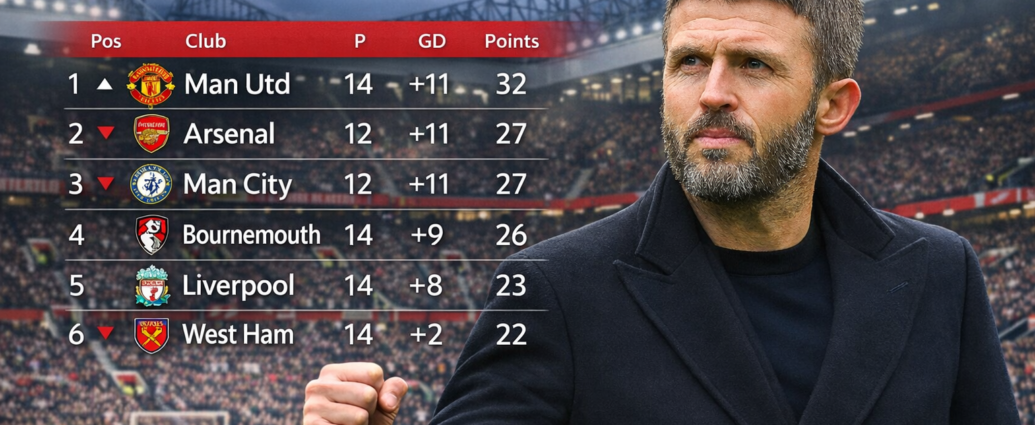
Manchester United’s resurgence under Michael Carrick has become one of the Premier League’s clearest examples of mid‑season transformation. His arrival in January 2026 introduced order, discipline and a tactical identity that reshaped the club’s direction. The improvement appears in results, match control and the renewed confidence visible across the squad.
Michael Carrick Manchester United stats highlight a sharp competitive shift
Carrick delivered 10 wins, two draws and two defeats across 14 Premier League matches. That return equals 2.29 points per match, placing him among the league’s most effective managers during that period. Independent tracking confirms the W10 D2 L2 run, reflecting stability and tactical clarity. United climbed into the top three with 64 points after 35 games, a rise that demonstrates Carrick’s influence on consistency and mentality.
A tactical structure built on balance and control
Carrick reintroduced a 4‑2‑3‑1 system that restored balance in midfield and improved United’s ability to dictate tempo. The double pivot strengthened defensive transitions, while the advanced midfield line supported sustained pressure in attacking zones. This structure reduced chaotic phases and allowed United to manage matches with greater authority. Every phase now reflects Carrick’s emphasis on spacing, rhythm and control.
A renewed identity shaped by discipline
United now operate with clarity, purpose and belief. The squad executes Carrick’s principles with precision, showing a collective understanding of roles and movement. The improvement extends beyond results; it signals a cultural reset. Carrick has not only stabilised the team — he has redefined its competitive identity. Manchester United now project structure, confidence and ambition as they push toward the league’s upper tier.